Diamonds are widely known as the ultimate symbol of love and luxury. But beyond their sparkling beauty, diamonds are true geological miracles. To truly understand how to identify a real diamond, we must first understand how they were born and why they possess such incredible physical characteristics.
How and Where Are Diamonds Formed?
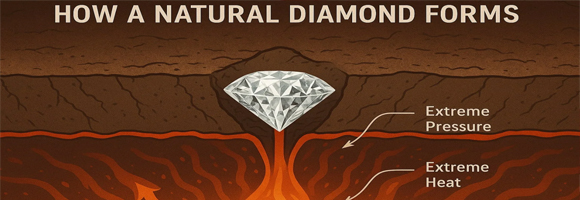
Unlike most gemstones that form in the Earth's crust, diamonds are born deep within the Earth's mantle, approximately 100 to 150 miles (160 to 240 kilometers) below the surface.
Billions of years ago, pure carbon elements were trapped in this deep zone. For these carbon atoms to crystalize into a diamond, two extreme conditions had to be met simultaneously:
- Extreme Heat: Temperatures reaching 2,000 to 2,200 degrees Fahrenheit (1,050 to 1,200 degrees Celsius).
- Extreme Pressure: Crushing pressure of roughly 725,000 pounds per square inch—about 50,000 times the atmospheric pressure at Earth's surface.
Under this intense hellish environment, the carbon atoms were forced to bond together in a rigid, 3D tetrahedral structure. Once formed, they remained hidden deep underground until violent, deep-source volcanic eruptions—known as Kimberlite eruptions—blasted them to the Earth's surface at supersonic speeds.
The Unique Characteristics of a Diamond (And Why They Happen)
That extreme birth process gives diamonds three highly unique characteristics that no other natural gemstone possesses:
1. Unmatched Hardness (Mohs Scale 10)
The Trait: A diamond is the hardest known natural material in the universe. It can scratch any other stone, but only another diamond can scratch a diamond.
The Why: Because of the extreme pressure during formation, every single carbon atom in a diamond shares tightly bound electrons with four neighboring carbon atoms. This interlocking 3D covalent lattice is incredibly difficult to break.
2. Incredible Brilliance and Fire
The Trait: When cut properly, a diamond bends light and breaks it into a rainbow of colors, creating its signature sparkle.
The Why: The dense carbon structure slows down light dramatically as it enters the stone. This high refractive index causes the light to bounce around the internal facets before returning to your eye as a brilliant flash.
3. Extreme Thermal Conductivity
The Trait: Diamonds draw heat away from objects instantly. They feel cold to the touch and can slice through ice like a hot knife through butter.
The Why: Heat travels through materials via atomic vibrations. Because a diamond's carbon lattice is so incredibly rigid and tightly packed, vibrations (heat) transfer through it almost instantly. In fact, diamonds conduct heat 5 times better than copper!
Test the Science Yourself
Because no fake stone can replicate a diamond's extreme thermal conductivity, the HMKIS Professional Diamond Tester uses a heated copper probe to measure how fast heat transfers through a gemstone. Verify the true nature of your diamonds with 100% scientific accuracy.
Get Your Tester on Amazon Read: How Testers Work