In our previous article, we mentioned that a high-quality thermal tester might falsely identify Corundum gemstones (like Rubies and Sapphires) as diamonds due to their excellent thermal conductivity. So, if your tester lights up, how do you verify if the stone is actually a highly valuable ruby rather than a diamond or a cheap fake?
Rubies are the most valuable members of the Corundum mineral family. To identify a true ruby, professionals look for these four core characteristics:
1. Color is King
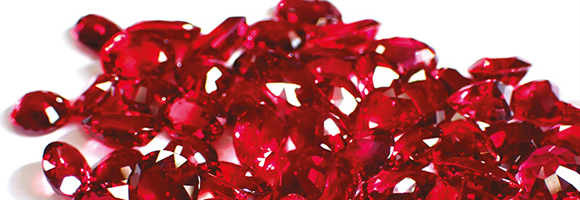
The value of a ruby is primarily determined by its color. The most highly prized rubies exhibit a pure, vibrant red or a slightly purplish-red hue (often referred to in the trade as "Pigeon Blood"). If the color is too dark, brownish, distinctly orange, or too light, its value drops significantly. In fact, if the red is too pale, the stone is technically classified as a Pink Sapphire rather than a Ruby.
2. Pleochroism (The Optical Key)
Natural rubies possess a distinct optical property called Dichroism. When you observe a real ruby under a light source and slowly rotate it, you will see alternating flashes of purplish-red and orange-red within the stone. If the stone only shows a single, flat shade of red from all angles, you are likely looking at a Red Spinel, a Garnet, or an artificial imitation.
3. Natural Flaws: "Nine out of Ten Rubies Have Cracks"
There is a famous saying in the jewelry world: "Nine out of ten rubies have cracks." A completely flawless natural ruby is incredibly rare. If you look inside the stone using a professional loupe, seeing natural inclusions (like fine rutile "silk" needles or tiny natural fractures) is actually a strong indicator of authenticity.
4. Extreme Hardness
Rubies have a Mohs hardness of 9.0, making them the second-hardest natural material on Earth, right after diamonds (Mohs 10). A genuine ruby is incredibly resistant to scratches. (Note: Never attempt to scratch a gemstone with a coin or glass in daily life. Leave destructive testing to certified gemological laboratories.)
How to Spot Common Imitations
- Red Spinel & Garnet: Their appearance is extremely similar to rubies. The best way to differentiate them is by checking for Dichroism (pleochroism). Spinels and Garnets lack the dual-color flashes seen in natural rubies.
- Red Glass: The cheapest and most common fake. Glass feels warmer to the touch, lacks the hardness of Corundum, and frequently contains tiny, perfectly round air bubbles inside—which you can easily spot with a magnifier.
Spot the Hidden Details with HMKIS
Diamond Tester Pen, Professional Jewelry Diamond Tester with 60X Jewelry Loupe Magnifier, Diamond Selector for Novice and Expert (Non-Rechargeable)
Get the Complete Testing Kit on Amazon